
Choosing the right platform to build your website can be tricky.
There are many options available ranging from off the shelf free website builders, through to a fully bespoke, custom-built website, plus all the options in between.
Each method has its own strengths and weaknesses, making the best choice dependent on your specific needs, technical skills, budget and long-term goals. Here, our co-founder Julie King runs through some of the pros and cons of each approach.
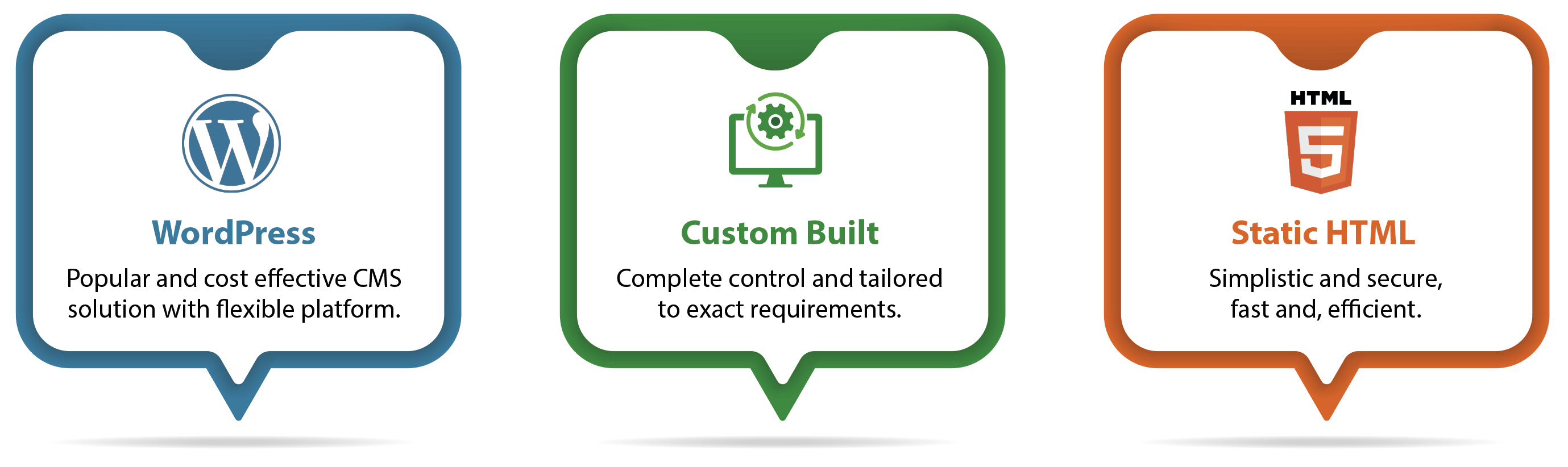
Designing and building a website involves a fundamental choice between three main approaches: using a Content Management System (CMS) like WordPress, opting for a bespoke (custom-built) solution or building a simple, static site with foundational languages like HTML.


Content Management Systems (CMS) e.g. WordPress websites
While there are many CMS solutions now available, WordPress remains the world’s most popular CMS. It’s a powerful and flexible platform that allows users to manage their website without needing extensive coding knowledge.
Advantages of building a website in WordPress:
- Ease of Use: WordPress has a relatively user-friendly interface that makes it easy to add content, manage pages and make updates without writing code.
- Cost-Effective: With all websites there are costs for a domain name and ongoing hosting, plus licences for premium design themes/plugins, however the WordPress software itself is free and open source. This makes it a highly affordable option, especially for small businesses and personal blogs.
- Extensive Functionality: Thanks to a vast library of design themes and premium plugins, you can add almost any feature you can imagine, from e-commerce stores (using WooCommerce) to membership sites, forums and booking systems.
- SEO-Friendly: WordPress is built with SEO in mind and has many powerful plugins to help optimize content.
Disadvantages of building a website in WordPress:
- Security Vulnerabilities: With it being an open source platform, it is crucial to stay on top of regular updates for the core software, themes and plugins to maintain security.
- Performance Issues: A WordPress site can become slow or “bloated” if you use too many plugins or a poorly coded theme. Optimizing for speed often requires additional effort and specialist tools.
- Ongoing Maintenance: If the site is not regularly maintained with regular backups and software updates, security and compatibility cam be compromised affecting performance and user experience.

Bespoke (Custom-Built) Websites
A bespoke website is one that is designed and coded from scratch by a team of professional developers. This approach offers complete control and is tailored to your exact specifications.
Advantages of a custom-built website:
- Complete Customization and Functionality: There are no limitations. You can create a website with a unique design and highly specific functionalities that perfectly align with your brand and business needs.
- Optimized Performance: A custom-built site is coded to be lightweight and efficient, with no unnecessary code or “bloat” from pre-built templates or plugins. This can result in much faster loading times and a better user experience.
- Enhanced Security: As the code is not widely used, it is generally more secure against common, automated attacks that target popular platforms like WordPress.
- Scalability: A custom-built site is designed to grow with your business. It’s easier to add new features and integrations as your needs evolve without being constrained by a pre-existing framework.
- Better SEO: With a bespoke site, developers can implement an SEO-first approach from the ground up, with clean, optimized code that search engines love.
Disadvantages of a custom-built website:
- Bigger Budget: Bespoke websites are significantly more expensive than template-based solutions due to the time and expertise required for custom development.
- Longer Development Time: Building a fully bespoke website from scratch takes a lot more time compared to using a CMS.
- Maintenance Reliance: You are typically dependent on the original development team for any updates, changes or maintenance, which can be an additional ongoing cost.

HTML Websites
An HTML website is the most basic form of a static site, built using HTML, CSS and
JavaScript. The content and structure are static, meaning they do not change unless the code is manually edited.
Advantages of an HTML website:
- Speed and Efficiency: With no database queries or server-side processing, static HTML sites are incredibly fast and lightweight.
- Simplicity and Security: The simplicity of a static HTML site makes it inherently more secure and less vulnerable to many types of attacks.
Disadvantages of an HTML website:
- Lack of Dynamic Functionality: HTML websites cannot handle dynamic features like user accounts, comments or live updates without incorporating more complex server-side languages.
- Difficult to Update: Every change to the content or design requires manually editing the code, which is time-consuming and can be difficult for non-technical users.
- Scalability Issues: Maintaining a large HTML website with hundreds of pages can become a nightmare, as a single change (like an update to the navigation menu) would have to be applied to every single page.
- Limited Design: While you can use CSS to style an HTML site, creating complex layouts can be a time-consuming manual process.
Picking the right website depends on what you need it to do, what you want your customers to be able to do, your budget and the in-house skills you might have to keep it updated.
If you are wondering if you should outsource your website, read our other handy article here: Why Should you Outsource Your Website? Because You’re Worth It.
And, if you need help maintaining your website, see how we could help: Beyond the Build: Why your website & app need a retainer.
For advice and guidance on which website is right for you, contact the 4FX team 01908 375200
to talk to us about your project. getintouch@4fx.co.uk.